The Leading Through Transformation series explores the intersection of leadership, technology, and operational impact, drawing on real-world industry experience and perspectives.
By Anne Partington, Managing Director and Head of Industry Partnerships, Tauber Institute for Global Operations, University of Michigan
Throughout my career in global purchasing, product development, and cross-functional leadership, one challenge has remained consistent: turning complex information into timely, effective decisions.
Today, organizations have unprecedented access to data through enterprise systems, supplier networks, advanced analytics, and artificial intelligence. Yet greater visibility does not necessarily translate into better decisions.
The speed of information has changed. Has the speed of organizational decision-making kept pace?
In many organizations, the answer is no.
The volume and velocity of data have outpaced the ability to synthesize information into actionable insights. Information remains fragmented across systems, functions, suppliers, and geographies. Leaders have greater visibility than ever before, yet often struggle to distinguish meaningful signals from noise and respond quickly enough to changing conditions.
The leadership challenge is no longer simply accessing more data. It is building the organizational capability to turn information into timely decisions, coordinated action, and measurable business value.
Monthly and quarterly reporting cycles have traditionally been central to understanding supplier performance, operational health, and emerging risks.
Those processes remain important for governance and performance evaluation. But they are no longer sufficient as the primary basis for managing dynamic global supply chains.
Supplier capacity, financial conditions, demand patterns, transportation networks, and geopolitical exposure can change rapidly, sometimes within days or hours.
A report that accurately describes last month’s performance may provide limited insight into tomorrow’s risk.
What matters is the ability to continuously synthesize information from multiple sources, identify meaningful trends, and understand how changes in one part of the system affect another.
AI and predictive analytics can accelerate this process by identifying patterns, highlighting anomalies, and supporting scenario analysis at a speed and scale that traditional methods cannot easily match.
A predictive model may identify a supplier capacity constraint. Leaders must still determine whether to adjust production, modify sourcing strategies, increase inventory, renegotiate commitments, or accept a calculated level of risk.
Information becomes valuable when it changes a decision. Decisions create value when they lead to effective action.
This challenge extends beyond technology. Procurement, engineering, manufacturing, logistics, finance, and suppliers often hold different pieces of the information needed to make consequential decisions.
Effective leadership requires bringing these perspectives together, establishing clear decision rights, and aligning teams around shared business outcomes.
As organizations adopt increasingly sophisticated analytical tools, systems thinking, critical judgment, communication, and cross-functional collaboration become even more important.
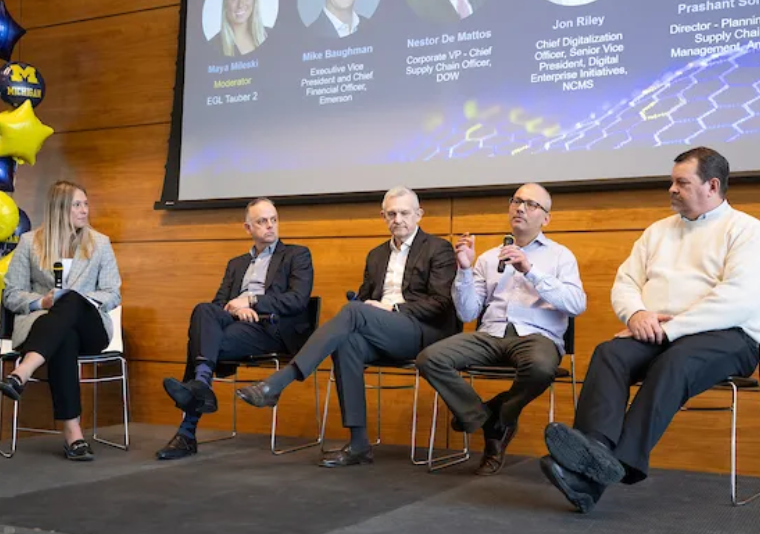
At Reuters Automotive USA 2026, I moderated a discussion on supply chain resilience with Neil Marsons, Chief Supply Chain Officer at Lucid Motors, and Mike Wall, Executive Director of Automotive Analysis at Mobility Global. Our discussion explored the challenge of turning supply chain visibility into timely, trusted decisions.
The underlying question extends far beyond automotive: Are organizations building the decision-making capabilities needed to keep pace with the information available to them?
For leaders evaluating their priorities for 2027, I would suggest starting with three questions:
The organizations that distinguish themselves will not necessarily be those with the most data or the most sophisticated technology.
They will be those that consistently turn information into better decisions, coordinated action, and sustained business value.
The Tauber Institute for Global Operations partners with organizations to address complex business challenges through interdisciplinary graduate student Team Projects, connecting business and engineering perspectives with practical problem-solving.
As we develop our 2027 project portfolio, we welcome conversations with industry leaders exploring opportunities in supply chain risk, advanced analytics, digital transformation, and operational performance.