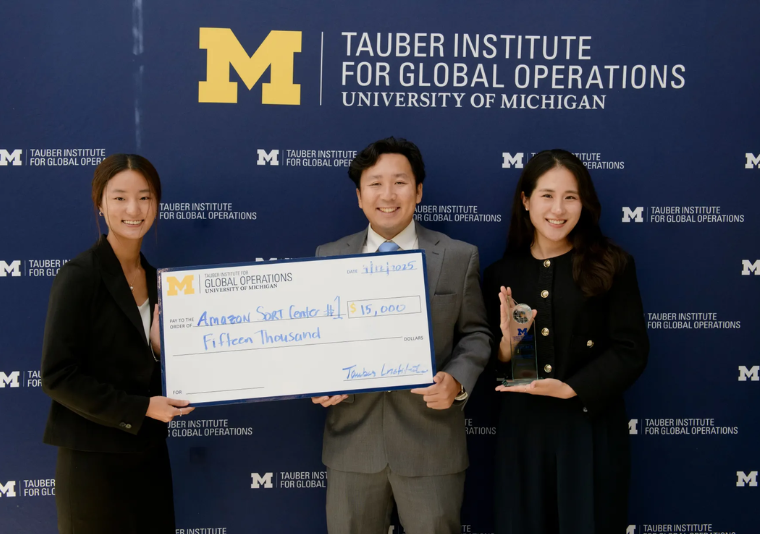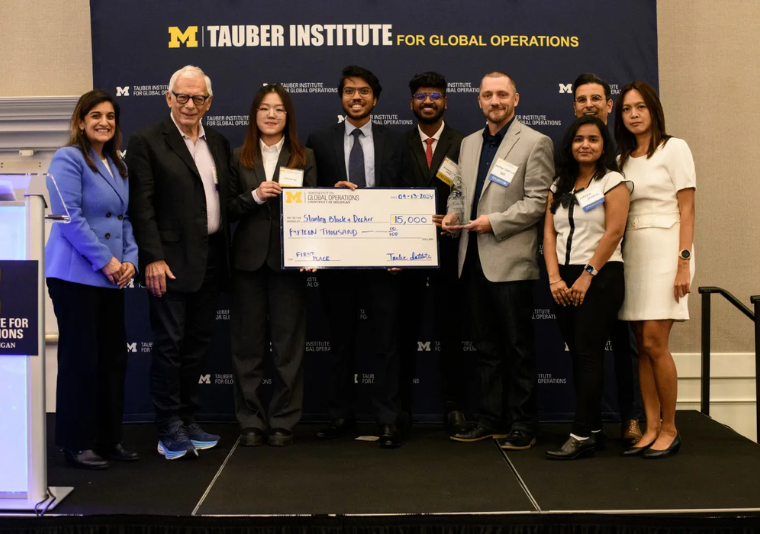
Ann Arbor, MI — Real companies, real stakes. University of Michigan Tauber Institute for Global Operations students from the Ross School of Business and the College of Engineering spent 12 weeks working on real-world challenges. Spotlight! is where teams presented their results to a room full of industry leaders, faculty, alumni, and fellow students and competed for scholarships.
Every year, Tauber student teams return to campus after completing their summer Team Projects to present the results of their work at Spotlight! During the competition, teams showcase solutions developed for sponsoring organizations and compete for academic scholarships.
Tauber Team Projects give students the opportunity to work directly with industry and organizational partners on complex operations and supply chain challenges. Teams typically bring together students from business and engineering, creating a multidisciplinary environment where analytical thinking, business strategy, and technical expertise converge to turn ideas into implementable solutions. The projects spanned artificial intelligence implementation, manufacturing, sustainability, strategy, data analytics, big data, and supply chain management.
The event featured 18 projects sponsored by 15 organizations: Amazon, Blue Origin, The Boeing Company, Conagra Brands, Eaton, Emerson, KROMATID, Michigan Medicine, Navitas Systems, National Center for Manufacturing Sciences, onsemi, Pfizer, Serva Group, Tenneco, and Vertiv.
While every team deserves recognition for its work, the following projects distinguished themselves among an impressive field. We’re proud to recognize the winners of the 2026 Spotlight! Competition:
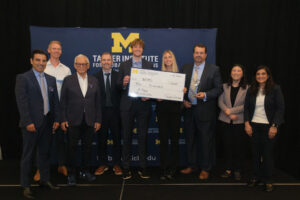
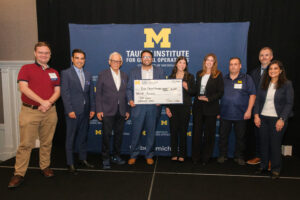
Student team: Oscar Roden (EGL) and Parker Peterson (EGL)
The Tauber team partnered with NCMS to develop a scalable platform for applying artificial intelligence to predictive maintenance in manufacturing operations. The project expanded an existing AI knowledge assistant to analyze equipment sensor data, diagnose potential failures, and recommend specific maintenance actions through secure cloud-based infrastructure. By delivering a tested prototype designed for users without data science expertise, the team created a practical tool to help manufacturers reduce unplanned downtime and make better use of existing sensor data.
NCMS – Scaling Integrated AI in Manufacturing project summary
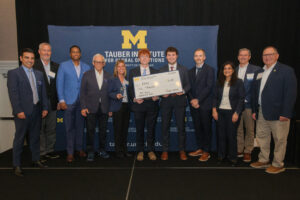
Student team: Hannah Bernardi (EGL), Hailey Mydock (EGL), and Neil Parekh (MBA)
Blue Origin’s Arlington, Washington, casting foundry produces seven investment-cast components for the BE-4 rocket engine. The Tauber team analyzed production workflows to identify opportunities to increase throughput without a proportional increase in cost. Using ERP data, technician interviews, and observations from the factory floor, the team developed a current-state value-stream map and a scalable capacity model. Its analysis identified inspection and rework as the primary bottlenecks, with short-term recommendations that could increase throughput by more than 15%.
Blue Origin – Blue Castings Foundry Improvement project summary
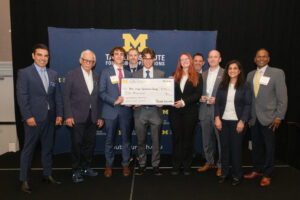
Student team: William Berschback (EGL) and Cole Martin (EGL)
Eaton’s Jackson, MI aerospace facility manufactures hydraulic, fuel, and thermal management conveyance products for defense and commercial aviation customers in a high-mix, low-volume environment. Taking a fresh-eyes approach, the Tauber team evaluated Eaton’s “Plan for Every Part” (PFEP) framework, and developed tools to improve planning parameters and replenishment strategies.. The team piloted the updated framework on a selected product line to improve manufacturing flow and customer on-time delivery while maintaining appropriate inventory levels.
Student team: Jack Brunell (EGL), Matthew Sinanis (EGL), and Makenzie Womack (EGL)
Blue Origin’s BE-3U upper-stage engine is produced in a shared facility that was not originally designed for high-volume manufacturing. To help production scale from tens to hundreds of engines per year without a proportional increase in capital spending, the Tauber team mapped critical production paths, built a validated digital twin, and developed a future-state factory layout. Three live pilots tested the recommendations on the factory floor, including a Kanban pull system that significantly reduced work-in-process inventory and freed more than $1 million in working capital on one production flow alone.
Blue Origin – Optimized BE-3U Factory project summary
Beyond recognizing the Spotlight! winners, the event celebrated the breadth and depth of industry engagement that continues to shape the Tauber Institute experience. This year’s judging panel brought together senior leaders from a range of industries, from organizations including General Motors, Vizient, Microsoft, Autoliv, Owens Corning, Bosch, Sartorius, Lineage, Ford Motor Company, LinkedIn, Marel Power Solutions, United Airlines, Wacker Chemical Corporation, High Potential Products, Dow, Toyota, Trinity Health, and Gentex.
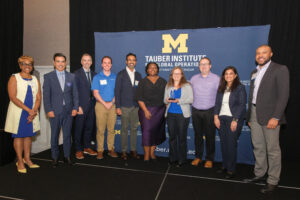
The event also provided an opportunity to showcase several longstanding Tauber partnerships. Boeing was honored for 30 years of sponsorship, marking three decades of collaboration with the Institute. American Industrial Partners was recognized for 10 years of projects, while Emerson was acknowledged for 5 years of project partnership.
The event also celebrated the lasting contributions of Tauber faculty. Amy Cohn, professor of industrial and operations engineering in the University of Michigan College of Engineering and chief transformation officer at Michigan Medicine, was honored for 20 years of advising Tauber Team Projects and mentoring students as they addressed complex operational challenges.
For more than three decades, Spotlight! has provided a stage for Tauber students to showcase the results of their Team Projects. The competition is one part of a larger model built around the intersection of business, engineering, and real-world operations experience. Ultimately, that’s what makes Spotlight! different from a traditional academic competition. The students aren’t responding to a hypothetical case. They’re presenting solutions to real organizational challenges. The experience and impact extend far beyond a single summer.
Interested in becoming part of the next chapter of the Tauber story? Qualified students can explore how to get involved with the Tauber Institute and pursue hands-on project opportunities, while industry and organizational leaders can learn how to partner with Tauber on future projects.
Start your journey with Tauber: Explore the Tauber student experience | Sponsor a Tauber Team Project