Student Team:
Karan Bhatia – Master of Supply Chain Management
Reshmi Chowdhury – Master of Supply Chain Management
Project Sponsors:
Dave Graybeal – Director, North American Customer Fulfillment
Govind Singh – Principal Program Manager, ACES Ops Integration
Faculty Advisors:
Matt Gibson – College of Engineering
M.S. Krishnan – Ross School of Business
Amazon, the largest online retailer in the world, operates a vast network of Fulfilment Centers (FC) across North America. Within FC operations, Inventory Control and Quality Assurance (ICQA) teams help in maintaining the inventory accuracy and quality within process paths. The goal of this project is aligned with the long-term vision of eliminating ICQA from FCs in the Amazon Robotics (AR) Sortable network.
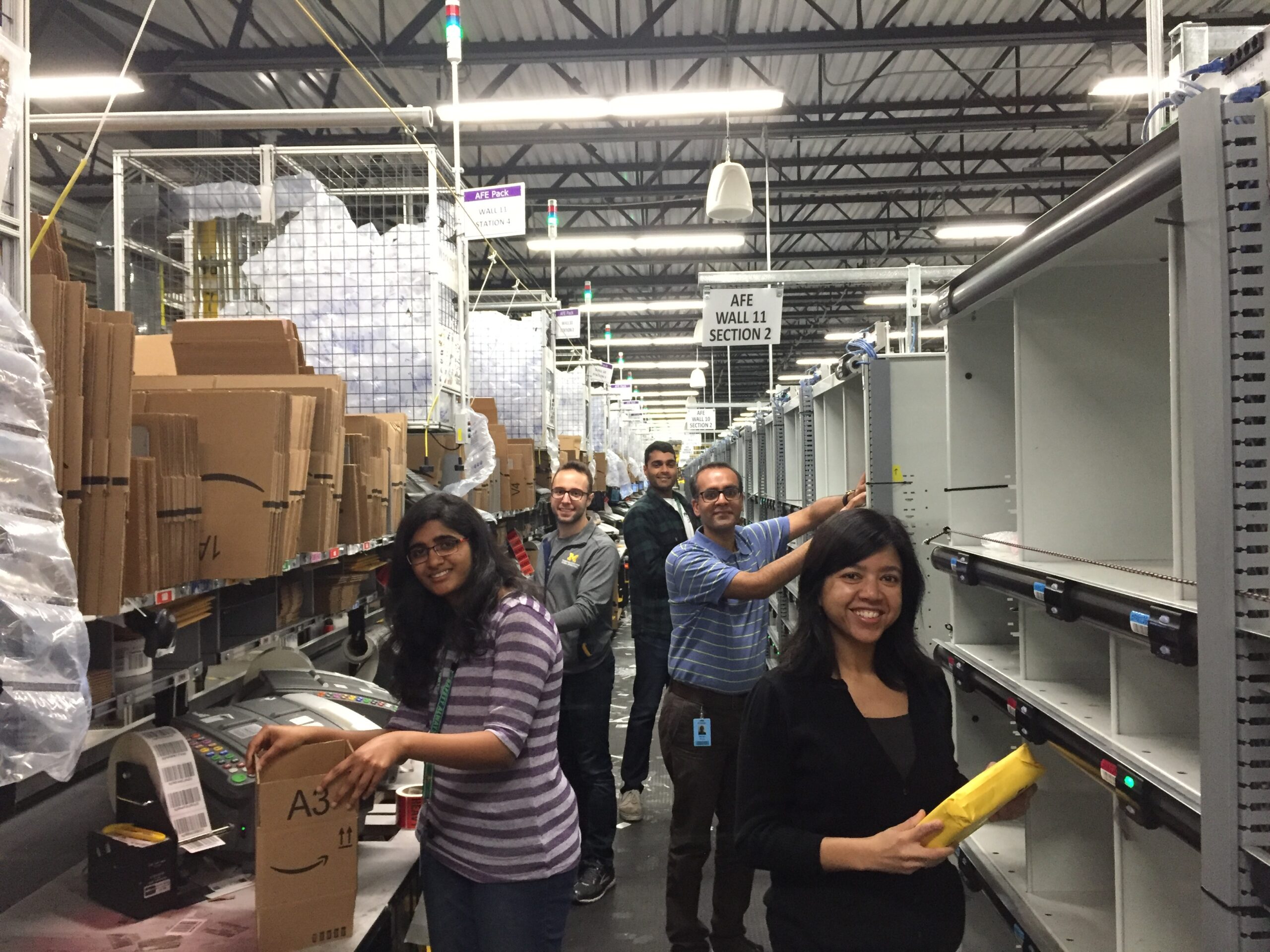
The team first created a strategy to integrate ICQA Count activities, amounting to 60% of ICQA labor hours, with existing workflows without compromising quality or other key metrics. After analyzing various process paths, integration with Pick and Stow process paths showed the most promise, as it will lead to maximum utilization of the already used station and tools and minimize deviation from the current processes. The intent of the integration is also to drive quality consciousness within the teams up to the Amazon Associate (AA) level. To see the concept in action and understand its impact on the operations metrics of productivity, operator utilization, and quality errors, the team designed the new integrated work processes and conducted a pilot study on the floor. With pilot iterations across different shifts, teams, and locations, the team saw a statistically significant improvement in operational metrics. Inputs from AAs, Operations experts, and the Robotics team were incorporated to create robust as well as simple new work process.
Next, the team led the cost-benefit analysis of the project and saw efficiency gains on various fronts. First, in absence of a simulation, the team used Little’s Law to calculate the change in the number of inventory pods coming to a station in today’s work stream vis-à-vis a future integrated work stream. With this, the team determined the reduction in robotic drives usage and identified potential savings of upwards of $170 M over the next three years. Next, the team conducted an in-depth study of the cycle time of the current and proposed work streams through on the floor pilots and historical data, and observed ~4.5% improvement in Operator Utilization (OU). Also, with no stations needed for Count in the future, every site will now have more Stow and Pick stations. With the increase in OU and number of stations, the network’s annual capacity will increase by 16%. This increase translates to labor hour savings of $740+ M over the next three years. Post integration, the sites will also see reductions in operational wastefulness. In fact, 14% of the current pod movements can be made redundant, leading to savings of $60+ M over the next three years. Finally, FCs will have the flexibility to better balance labor requirements since sites will no longer have an indirect Count function. This will lead to further savings of close to $10 M over the next three years due to better resource allocation and labor planning. In total, the network benefits over $1 billion over the next three years with this integration.
For successful process change on the floor, key buy-in from associates was required. Thus, associate feedback and openness toward changed workflows was collected and feedback was very positive. The cross-function transfer request data yielded similar insights. The data also projected the strong pull of Stow and Pick associates to incorporate ICQA count functions. Post-pilot feedback has been even more encouraging with pilot associates finding the new integrated job easy to learn and less tiring. The above analysis and NPV upwards of $700 M, calculated over next three years, made an integration use-case more compelling. The team wrapped up by creating a business case for funding the project and creating handover plans for Amazon teams who will be driving the project for North American network-wide implementation in existing and future sites.