News
Welcome to Tauber Institute for Global Operations News.
Explore our press releases, feature articles, and announcements about Tauber students, speakers, team projects, and events.

Welcome to Tauber Institute for Global Operations News.
Explore our press releases, feature articles, and announcements about Tauber students, speakers, team projects, and events.
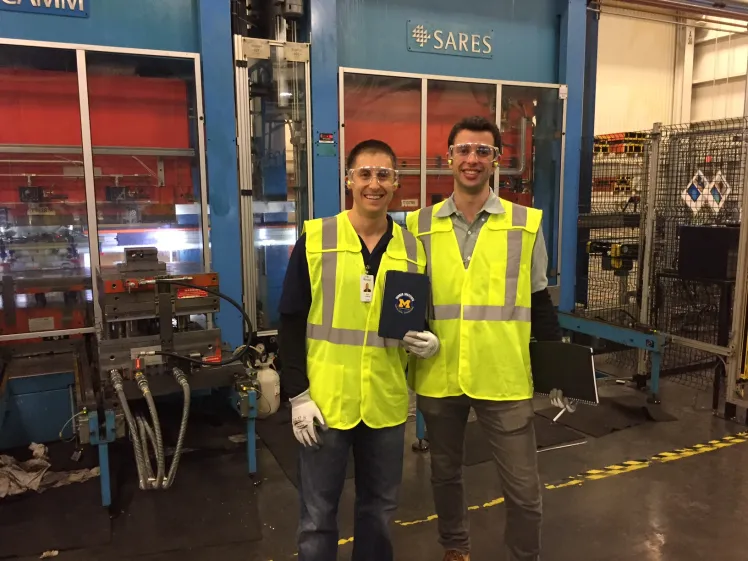
Whirlpool Corporation presented a mystery and a method to their 2017 Tauber Team: Solve the puzzle of the cracked oven cavities, using predictive analytics. The team broke the case, and identified multi-million-dollar savings opportunities. They went on to take second place among 32 teams entered in the annual Tauber Institute Spotlight! Team Project Showcase and Scholarship Competition.
PREDICTIVE ANALYTICS AND
THE CASE OF THE CRACKED CAVITY
Tauber Team Tasked with Strategic Assessment
to Solve a Manufacturing Mystery
Operations management may go back 7,000 years, but the fundamental drive to improve efficiency and effectiveness is timeless, and the urgency around this challenge seems to grow daily. Increased systems complexity deepens the challenge. The current Industry 4.0 trend yields a smart factory comprising cyber-physical systems, the Internet of things, and cloud computing. For a recent quest to reveal how best to employ predictive analytics, Michigan-based manufacturing giant Whirlpool returned to a resource that has served it well before: a student team from the Tauber Institute for Global Operations.
Whirlpool Corporation generated nearly $21 billion in sales in 2016; the company markets several brands of major home appliances worldwide. Their Advanced Manufacturing (AM) team is the innovation incubator for Whirlpool’s initiative to achieve enterprise-wide Industry 4.0 standards. The Tauber Team— Ignacio Estrada Garcia (Master of Mechanical Engineering and Management) and Ryan Colameo (Master of Business Administration)—was tasked with completing a strategic assessment of the predictive analytics opportunities for some of the more complex machines at the SARES Line in Cleveland, Tennessee, which manufactures oven cavities for the Minerva oven line; during the forming process, there had been frequent, but seemingly random, instances of oven cavities developing rib cracks. Work included these elements:
A Resolution, and a Way Forward
The trial tests pointed the team in the right direction, yielding the insight that materials properties were playing a significant role, and that the press nerving center was also relevant to the problem. The team identified new data-streams Whirlpool should consider, including the next version of the predictive model, and developed a template framework called (aptly) “The Tauber Framework” to guide the approach to future predictive analytics implementations. The tool will help project leads outline critical tasks for subsequent projects, regardless of the specific process under examination. Ryan Colameo noted that while this type of projects has relatively high upfront costs, the marginal cost of additional projects is lower. In this project, “a savings opportunity of $150K annually was identified, with approximately 50% of this being able to be realized within the next year. Expanding this application across the enterprise represents an annual opportunity of ~$12M globally over the next three to five years. Near-term ROIs are in the 18-37% range, while long term average returns tend to be much larger.”
Navigating the Process
Faculty advisor Ariel Shwayder believes the dedicated support team of University of Michigan faculty advisors, research librarians, and communications specialists each Tauber students come with “allows [them] to dig into the topic(s) more deeply and have more impact. It also creates a structure around the team project.” In this case, both Estrada Garcia and Colameo made special acknowledgement of the academic resources available through the Michigan Ross Kresge Library, and librarian Halley Todd’s assistance in gathering academic papers and journal articles relating to predictive analytics in manufacturing, which helped them better understand the steps necessary to implement machine learning. And for the first time this year, the support team expanded to include a Tauber alumnus as mentor. Estrada Garcia shared that Jim Beaver (MSCM '12), Commodity Sourcing Manager at Parker Hannifin, counseled the team on networking and project management, and “his insights allowed us to be more efficient throughout the project.”
The team’s work was also enriched by visiting the Whirlpool manufacturing plant in Tennessee, where Estrada Garcia and Colameo learned more about the specific equipment they would focus on, and spoke with a range of stakeholders, including process engineers, financial analysts, and maintenance workers. Colameo asserts that “getting support from operators on the manufacturing floor was critical to our success. They were knowledgeable about the machinery, and genuinely wanted to make things better. Their insights and observations were invaluable in generating our hypotheses and directing us to trouble areas that needed improvement.”
Team Benefits
The opportunity to apply classroom learning in a real-world setting had multiple benefits for this team. Estrada Garcia cited better understanding of the complex nature of manufacturing, which underscored how conflicting priorities can impede progress. He also noted, “Getting things right the first time around matters, and there are no trivial tasks. Everything needs to be done with an end goal in mind, and ensuring that everything will work together.”
Colameo, meanwhile, generated a handy list:
Whirlpool Team
Student Team
Ignacio Estrada Garcia—Master of Mechanical Engineering and Management
Ryan Colameo—Master of Business Administration
Project Sponsors
Audrey Hettig—Lead Process Engineer, Whirlpool (project supervisor)
Faculty Advisors
Ari Shwayder—Ross School of Business
Dawn White—School of Engineering
About Tauber Team Projects
Each two- to three-person Tauber Team consists of graduate students in Engineering, MBA, and/or MSCM programs. Along with receiving high-level corporate support from the sponsoring company, each team is advised by a College of Engineering and a Ross School of Business faculty member, and overseen by a Tauber Institute Co-Director. The projects begin on-site in May and continue for 14 weeks. Students present the results of their projects and compete for over $40,000 in scholarships at the U-M Tauber Institute’s annual Spotlight! event, held each September in Ann Arbor, Michigan. Spotlight! provides outstanding opportunities for students and corporate partners to establish relationships while exploring innovations in operations and manufacturing.
The 2017 Tauber Team Projects resulted in $575 million in savings according to sponsoring company calculations, an average of $18.5 million per project over three years.
To learn more about the Tauber Institute for Global Operations, visit tauber.umich.edu/ or call us at (734) 647-1333.