News
Welcome to Tauber Institute for Global Operations News.
Explore our press releases, feature articles, and announcements about Tauber students, speakers, team projects, and events.

Welcome to Tauber Institute for Global Operations News.
Explore our press releases, feature articles, and announcements about Tauber students, speakers, team projects, and events.

ANN ARBOR, Mich. — Professor William Lovejoy has seen some impressive and original products come out of his renowned Integrated Product Development (IPD) course at the University of Michigan. Teams comprised of students from business, engineering and design backgrounds have consistently created products that meet a need, are sustainable, and in certain cases, have had humanitarian implications. The focus of the course has evolved along with students’ interests and the marketplace, and this year, the cross-disciplinary IPD teams put their collective skills to work on locally-sourced, locally-manufactured products.
Lovejoy and co-instructor, Professor John Marshall from the School of Art and Design, challenged the 2013 IPD class to design easily-assembled and locally-fabricated dormitory furniture using a local makerspace or cooperative workshop that houses sophisticated fabrication equipment and the staff to operate it. The new makerspace business model is made possible by advances in manufacturing technology that allows people (including entrepreneurs) to pay a nominal monthly fee for access to sophisticated manufacturing systems including computer-controlled routers and sanders, electronics equipment, welding shops and combinations of all types of fabrication tools.
“We always look for projects that are interesting to the students. The trend that has been consistent over the past three years is that it be something that could be a small business unto itself, as opposed to a singular product,” said Lovejoy.
“Around that theme, this generation of students is quite socially sensitive and wants to help others -- and they are ecologically aware as well. That’s what I think is so great about them.”
Teams researched by going into dorms, interviewing students and brainstorming ways to make dorm living more livable. They asked students what they needed in terms of functionality and what they thought they could assemble themselves. They came up with the following innovative ideas using simple materials and creative marketing.
"It was a learning process to do the ethnographic research in the beginning on the individual users, which were students in the dorm. It was good to see us all working together,” said Kelly of the collaborative spirit demonstrated by team Elevate.
Unit team member Masayuki Kawasaki, MBA ’14, whose family is in the manufacturing business in Japan, said the entire process of this class was learning experience, and he especially appreciated the chance to work with students from the College of Engineering.
IPD 2013 Teams in order of Profitability:
Unit: modular shelving/stools
QUB: storage stool
Elevate: vertical shelving
Embed: bed desk
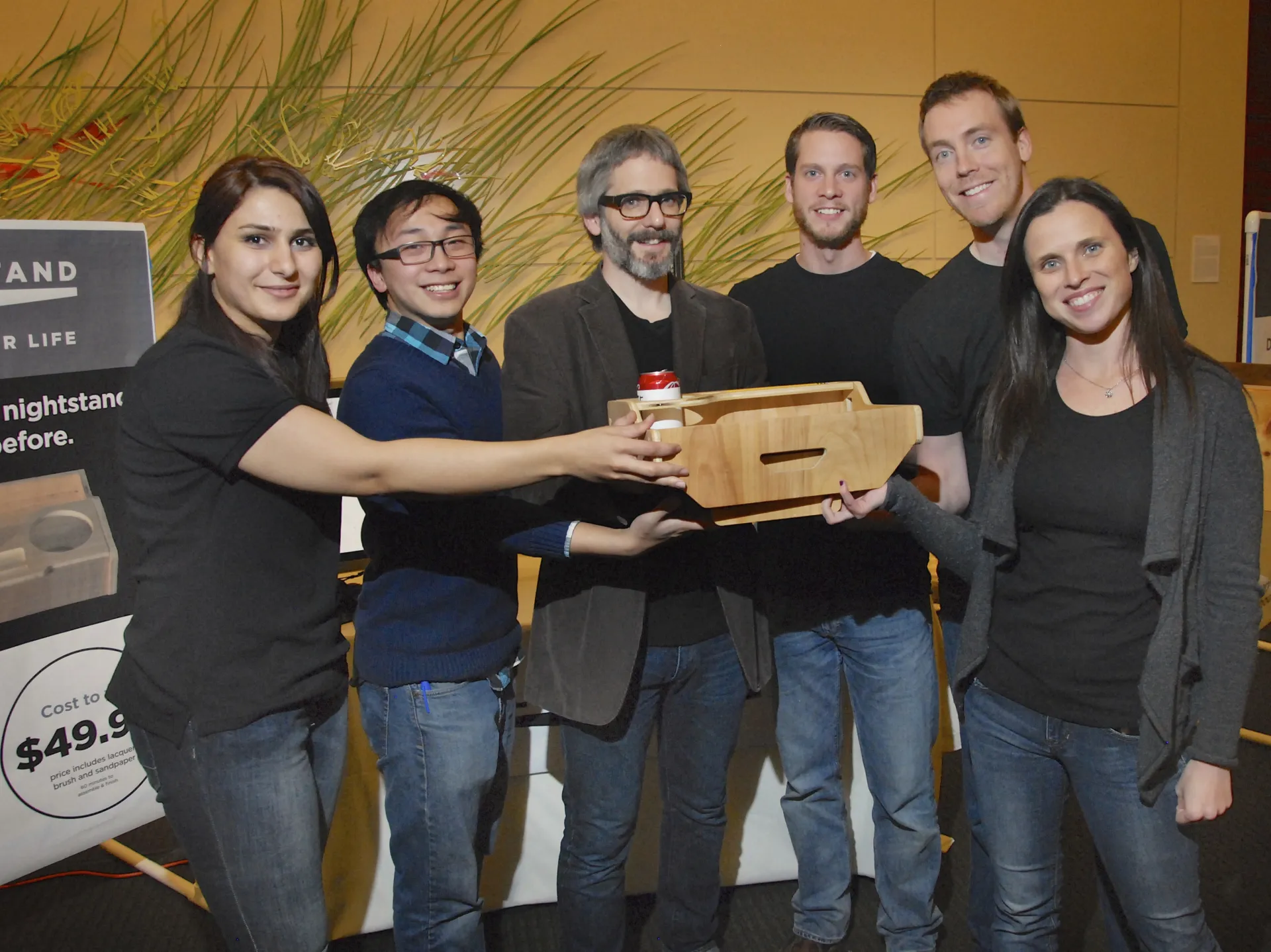
Flightstand: bedside table
Snap Rac: clothing rack
EZA: acoustic smartphone amplifier
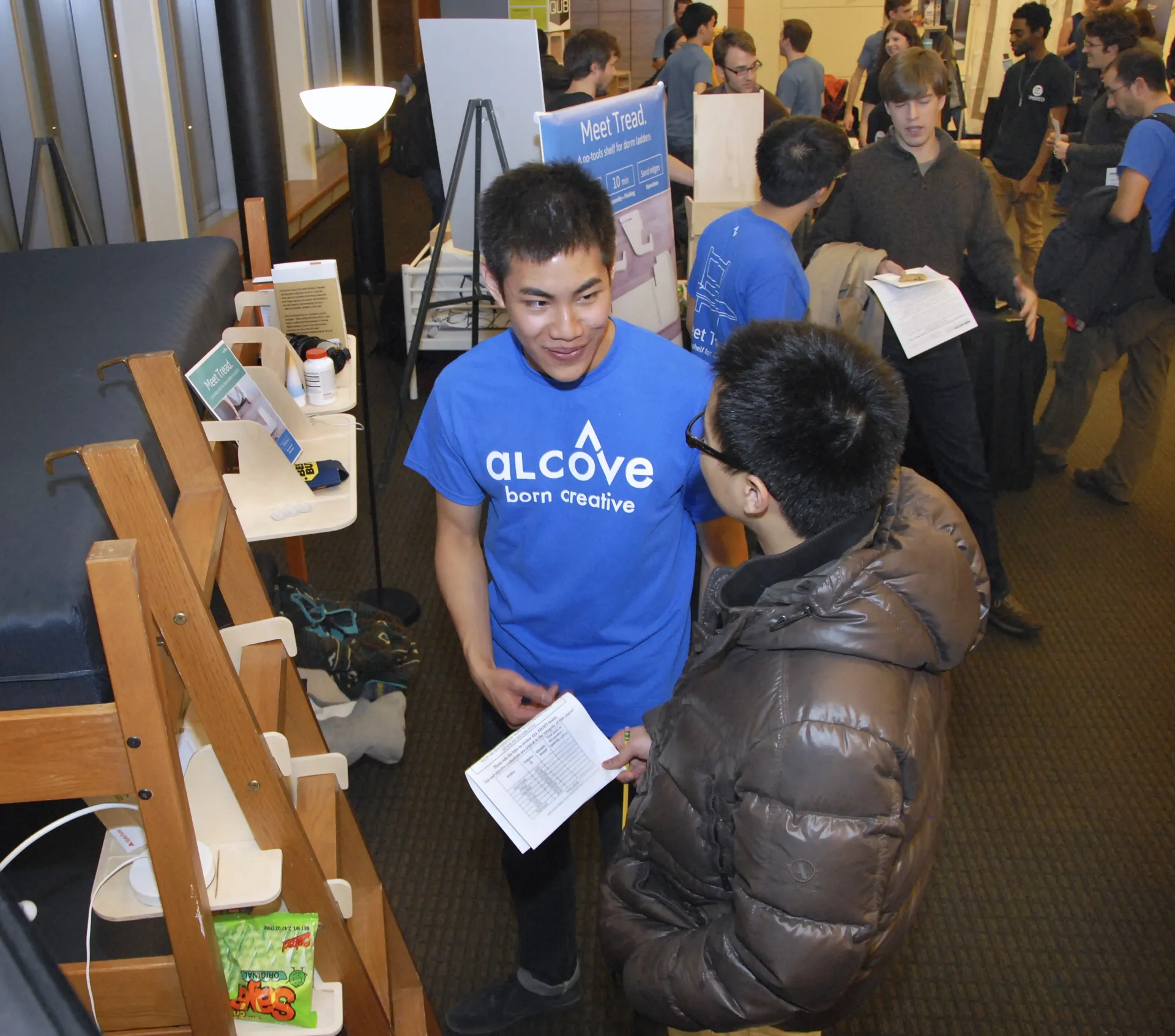
Treads: bunk-ladder shelf
“The project challenge was to create something users with entry-level skills and limited tools could assemble, based on the IKEA model. Most of the projects had no fasteners. Customers don’t see or know what goes into creating that friction fit-style. It is a throwback to real craftsmanship on a local level,” Lovejoy said. The materials were sourced from local lumber stores, home improvement centers and online stores like Amazon that could drop ship required hardware in a matter of a few days.
“Creating something, a product from concept through development and working all the way to selling it gives you a holistic view about how to market and sell. The entire experience is valuable. I’ve never had this type of experience before in my career,” said Liz Liu, MSC.
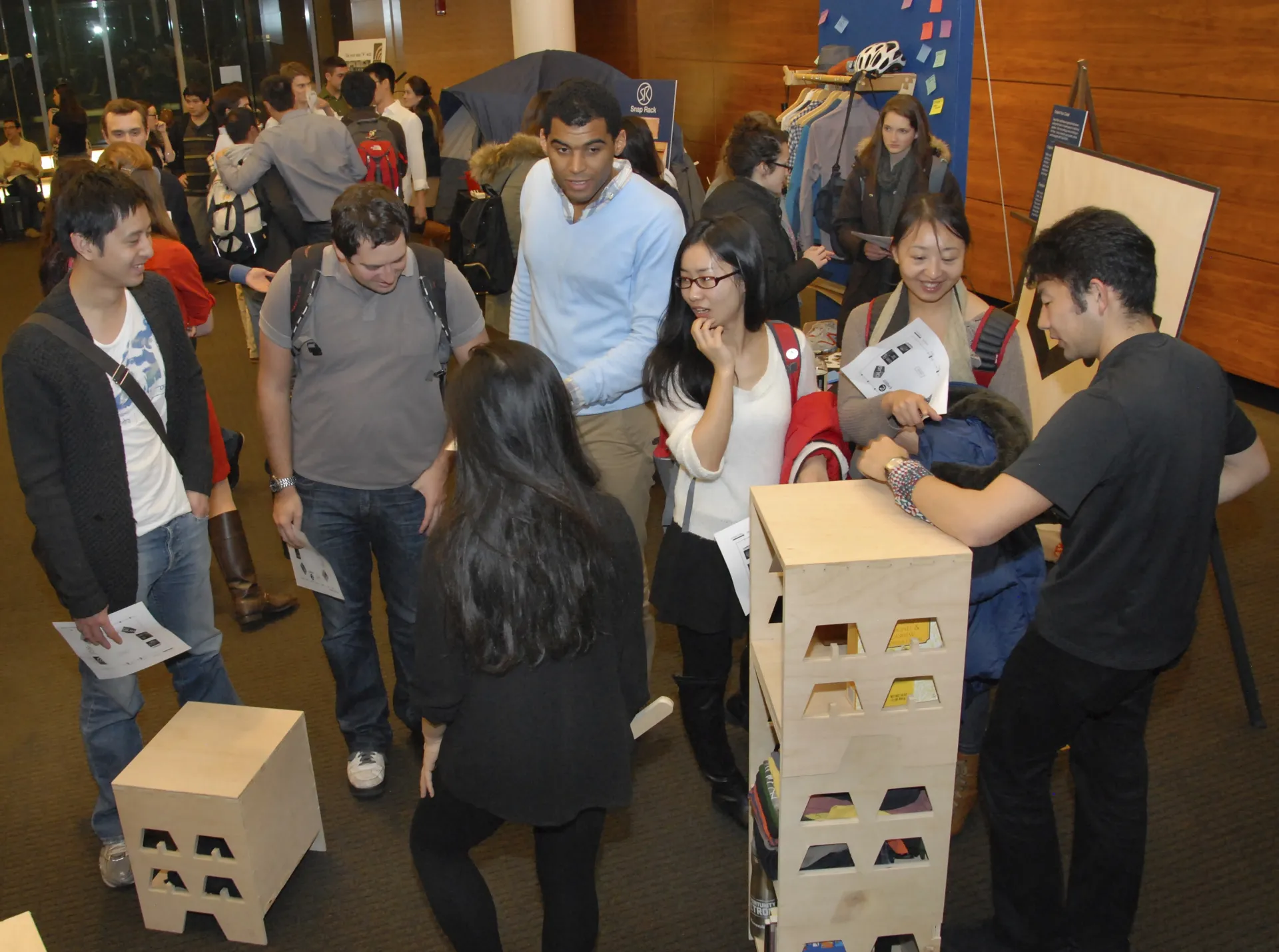
The IPD online and physical trade shows held in early December gave more than 1,000 potential consumers the chance to evaluate the items they found to be the most useful. Teams were also able to take feedback and re-evaluate following the online show in order to tweak their products for the physical trade show. A twist in the normal voting this year was the addition of $200 in virtual money that voters could spend on their top choices. Lovejoy said that the amount was calculated to allow for “leftover” funds that would spread sales across several products.
Though Prof. Lovejoy is hesitant to call out one team as the “winner” of the challenge, it is clear from the voting that the Unit team came out on top in terms of total trade show profit at $46,068.17.
For more information about the IPD trade shows or course, please contact Tauber at (734) 647-0308 or email [email protected].
About Tauber Institute for Global Operations
The Tauber Institute for Global Operations is a joint venture between the University of Michigan’s Stephen M. Ross School of Business and the College of Engineering, and many industry partners to facilitate cross-disciplinary education in global operations management. In addition to broad array of core and elective courses, the innovative LeadershipAdvantageSM Program provides students with the tools to ascend to major operations leadership roles. Well-designed and managed team projects form the cornerstone of the Tauber Institute experience and allow students to apply their knowledge to real world settings. The Tauber Institute is an inaugural recipient of the UPS George D. Smith Prize for effective and innovative preparation of students to be good practitioners of operations research, management science, or analytics. http://www.tauber.umich.edu
Contact:
Theresa Ceccarelli 734-647-0308 [email protected]