

A message from Anne Partington, Managing Director, Tauber Institute for Global Operations
In operations, we are trained to quantify risk. We model it, build safeguards, and design for resilience.
Artificial intelligence is accelerating complexity faster than most organizations are prepared to absorb. Decision cycles are compressing. Data volumes are expanding. Supply chains remain volatile. The margin for delayed response is narrowing.
AI will not eliminate complexity. It will expose it.
Competitive advantage now depends on how quickly organizations interpret signals and act with precision. But speed alone is not the differentiator. Adaptive advantage belongs to organizations that can evolve their systems and their cultures under pressure.
That is why our Global Operations Conference focused on Artificial Intelligence and Innovation in Operations.
AI is no longer theoretical. It is embedded in forecasting models, procurement systems, manufacturing networks, and digital infrastructure. Through panels such as The Future of Operations: AI Integration and Beyond, Demystifying Data Centers and Why They Matter, and Preparing Future-Ready Leaders for the Age of Intelligent Enterprises, board members, faculty, industry leaders, and students examined what this shift demands.
One theme emerged clearly. Resilience in the AI era is not about redundancy. It is about adaptive capacity.
AI can optimize systems, surface patterns, and accelerate decisions.
It cannot replace judgment, cross-functional trust, or leaders who understand how interconnected modern operations truly are.
The AI era is not only a technical transformation. It is a human one.
Having led large-scale operational transformations in industry, I have seen firsthand that technology accelerates outcomes, but culture determines them.
In many organizations, AI will magnify existing cultural fractures rather than resolve them. If trust is weak, alignment unclear, or accountability diffused, intelligent systems will amplify those gaps.
Psychological safety is not a cultural aspiration. It is an operational requirement.
In AI-driven environments, risks must surface early, and learning must occur in real time. Leaders must design environments where assumptions are challenged, cross-disciplinary voices are valued, and human judgment is strengthened. Without trust and psychological safety, even the most advanced AI systems underperform.
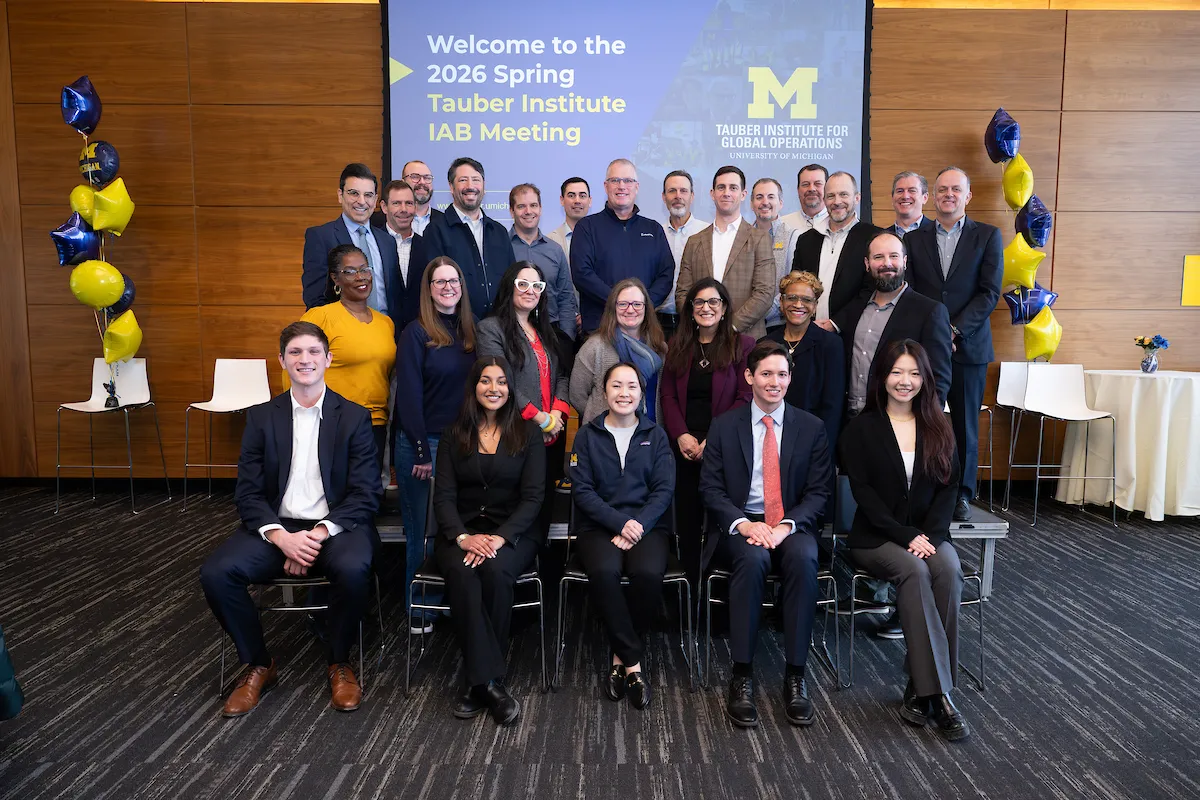
With nearly 25% percent of our conference participants representing industry, this was not a classroom exercise. It was a shared learning platform. AI is evolving too quickly for any sector or generation to claim mastery. A growth mindset is required at every stage of a career.
The strongest organizations are building three capabilities simultaneously: technical intelligence, systems thinking, and relational infrastructure.
For Tauber students, this matters immediately. Tauber Team Projects are multidisciplinary by design. Business school and engineering students work side by side to solve complex operational challenges for industry partners, many involving data visibility, automation strategy, process intelligence, and AI-enabled decision support.
Students will be expected to contribute in environments where AI is already shaping operational decisions. They must enter ready not only with analytical tools, but with systems thinking, cultural intelligence, cross-functional collaboration skills, and the confidence to ask sharper strategic questions.
The conference is an example of a strategic learning platform. It connects academic rigor with real-time industry adaptation. It reinforces that future-ready leaders are defined not by fluency in technology alone, but by their ability to integrate it thoughtfully, lead across disciplines, and deliver impact in complex global systems.
Adaptive advantage is not about reacting faster. It is about intentionally designing systems and cultures that can evolve under sustained pressure.
Operational excellence has always required rigor. The AI era requires intentional design.
Resilience is engineered.
We do not build resilient systems alone. We build them by learning and climbing together.
— Anne Partington
Managing Director, Tauber Institute for Global Operations